Score your room from one photo
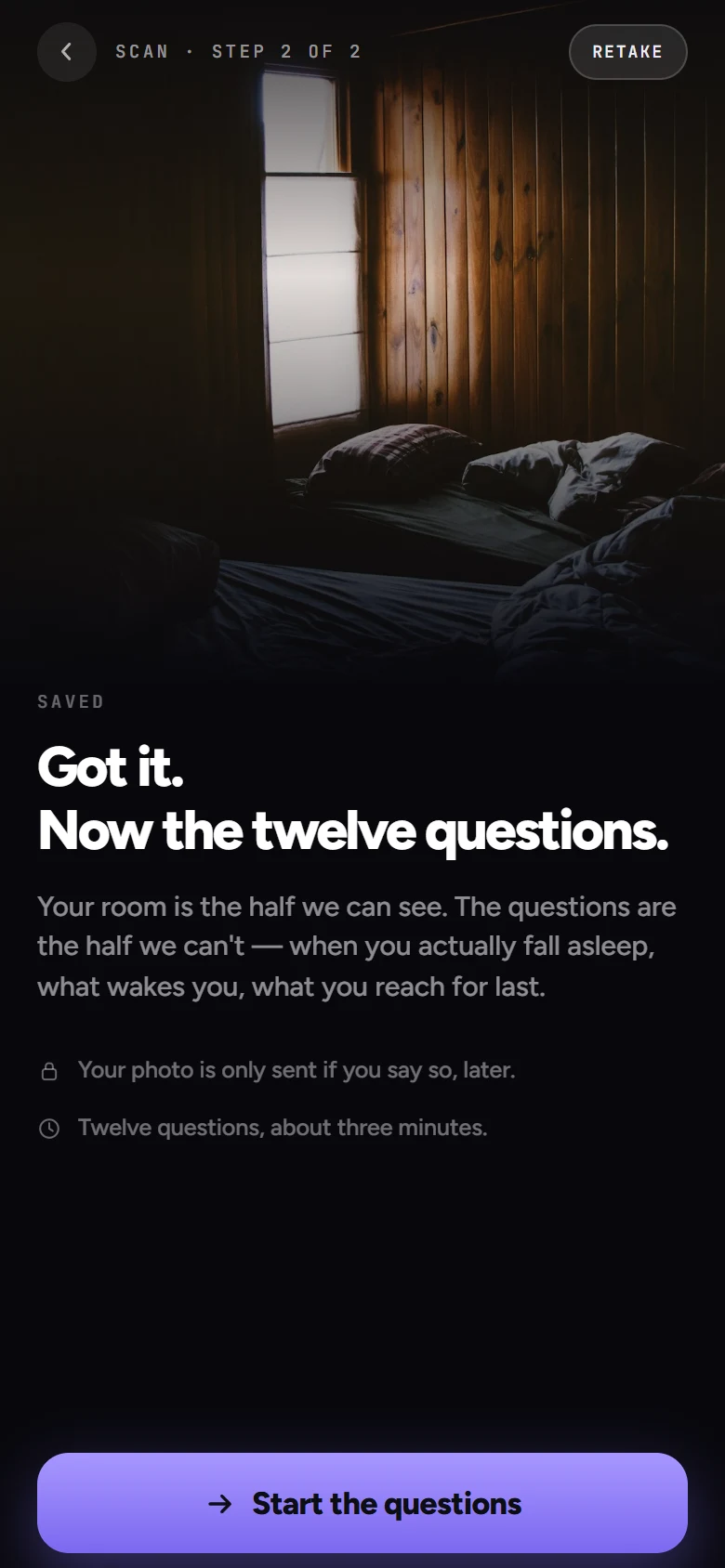
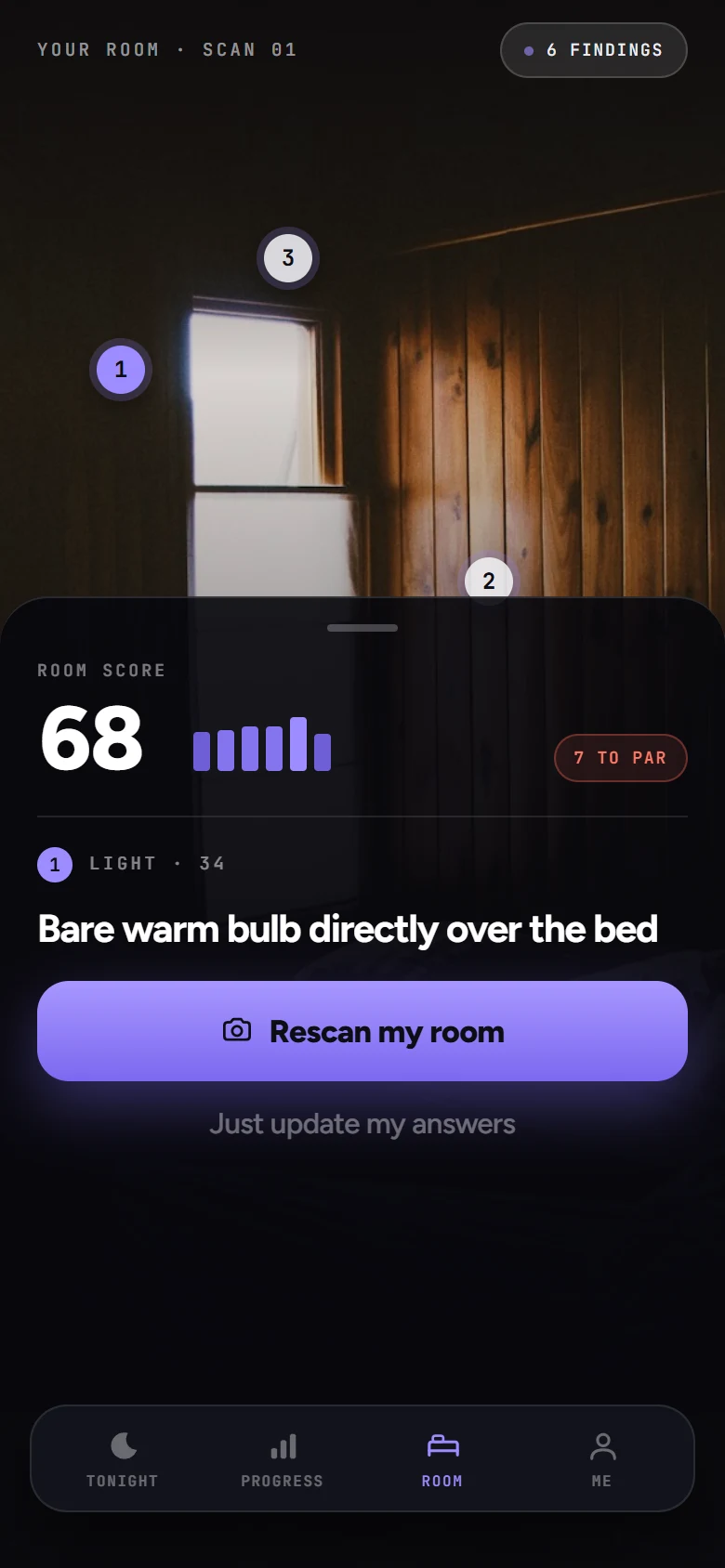
Take one picture of where you sleep. We read the light sources, the screens, the clutter and the ventilation that are actually visible in the frame.
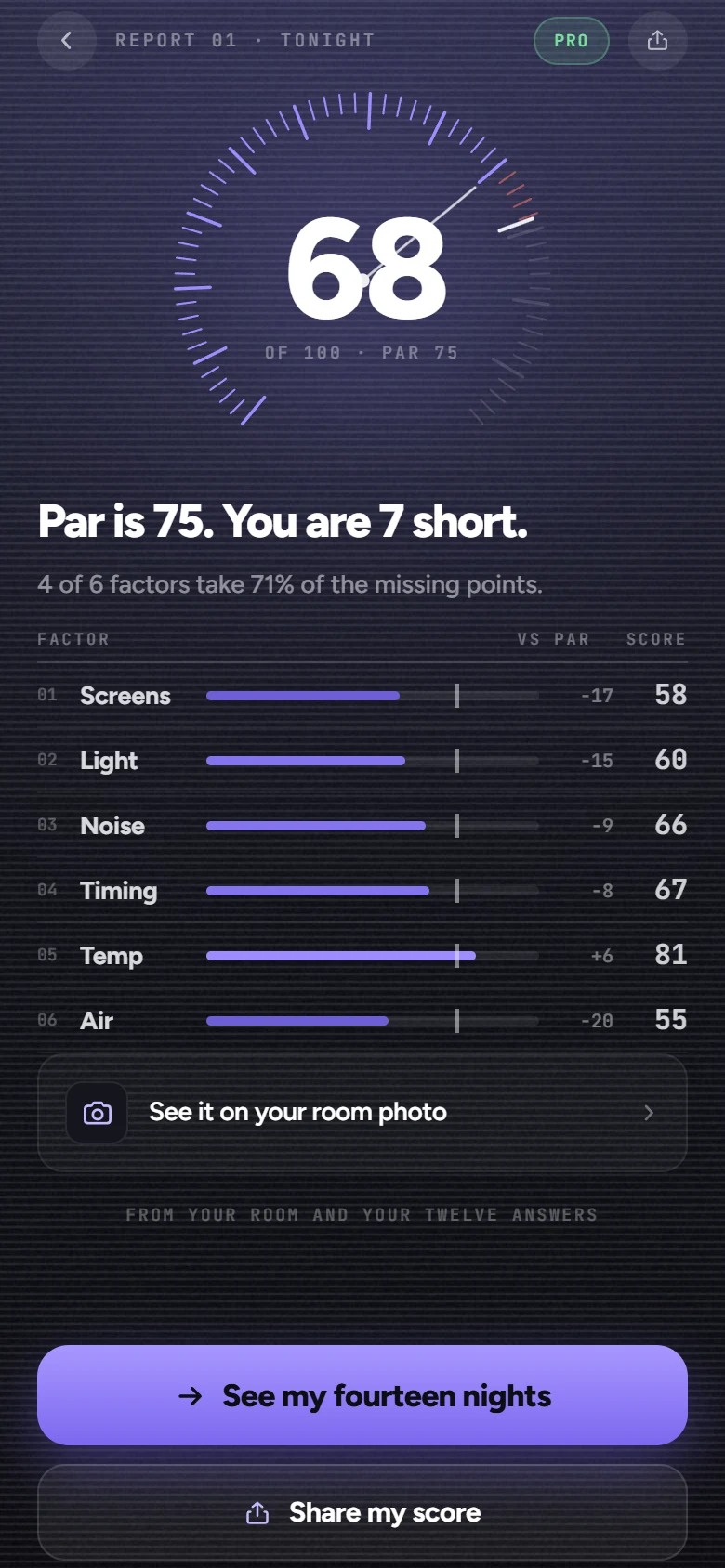
Photograph your bedroom, answer twelve quick questions, and get your Sleep Score out of 100 — against par 75, the score of a room that isn't working against you.
You're on the list. We'll write once, the day it ships.
It scores the room you sleep in, then tells you what to change first — and what each change is worth.
Take one picture of where you sleep. We read the light sources, the screens, the clutter and the ventilation that are actually visible in the frame.
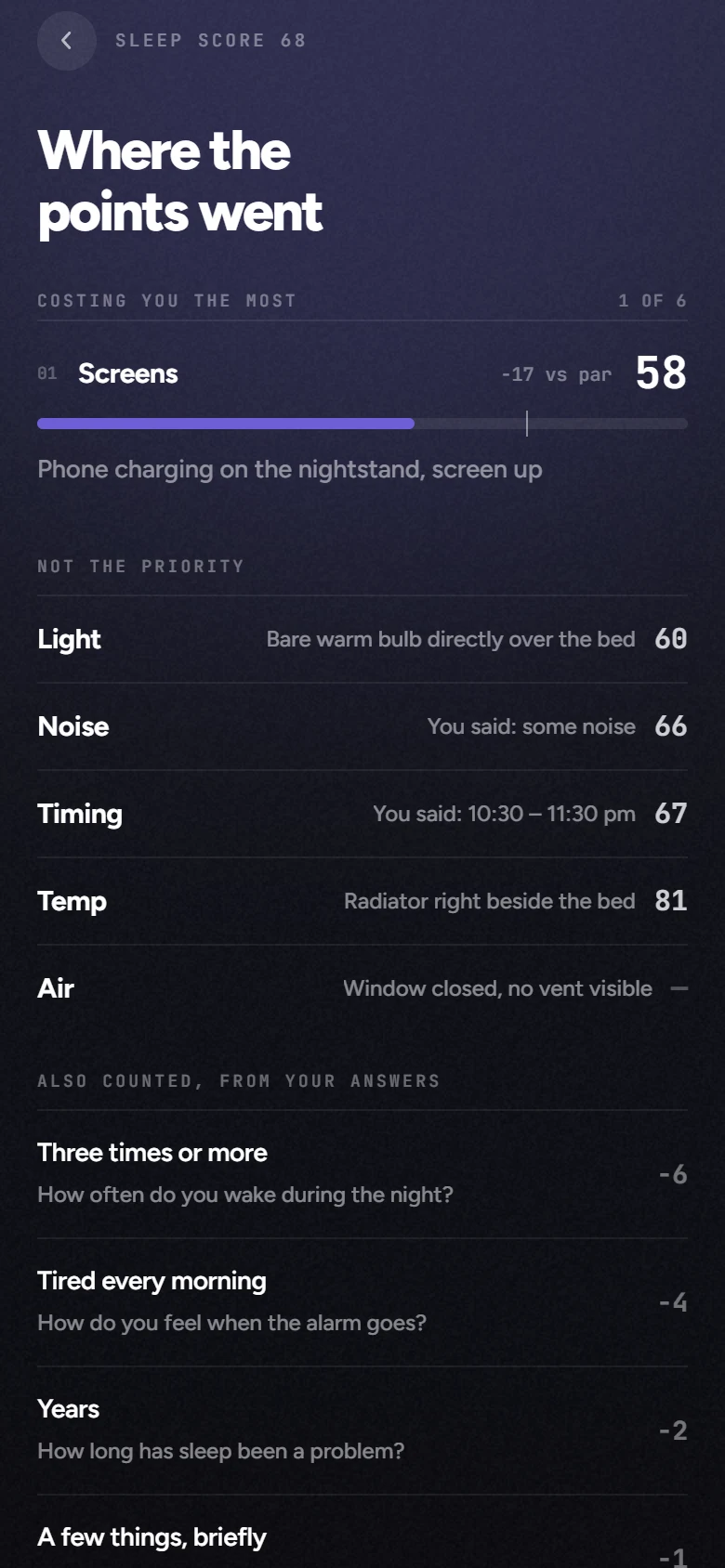
Six factors, ranked by what they cost you, each against par. Every line says whether it came from your photo or your own answer — and when the photo can't tell, the app says so.
A handful of changes ranked by what they give back. Move the charger, warm the bulb, crack the window. Most of them cost nothing.
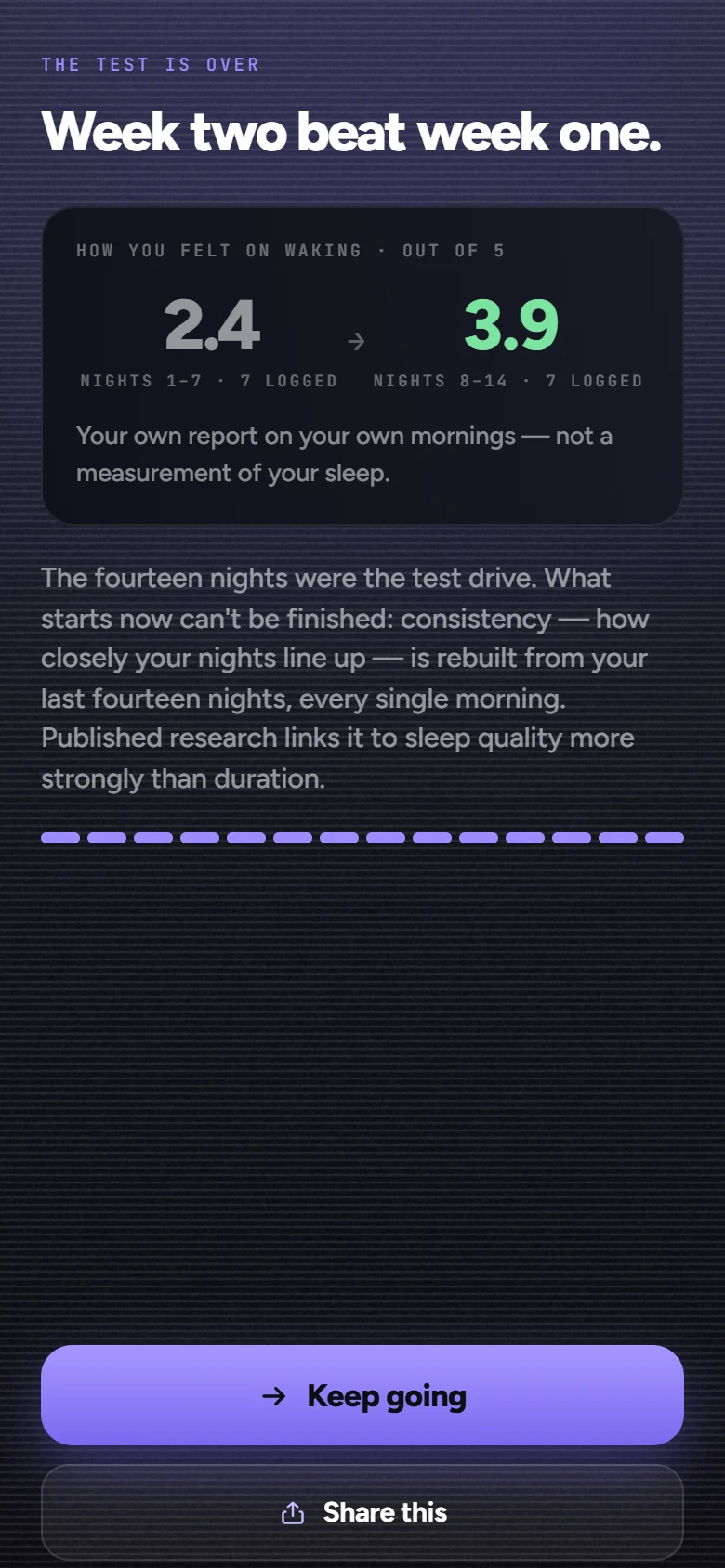
From night fifteen, consistency takes over — how closely your nights line up, rebuilt from your last fourteen nights every single morning. It can't be finished.
Half of them are usually free to fix, and most people have never looked at any of them.
The white mark is par, 75 — the target the app sets for a room that isn't working against you. Red = costing you points.
A standby LED, a gap under the door, a streetlamp through thin curtains. Your body reads any of it as "not night yet".
Where the charger lives decides how the last forty minutes of your day go. Usually the answer is: in the bed, within arm's reach.
Stale air builds up over eight hours in a closed room. Cracking one window is free, and you can try it tonight.
Your core temperature has to drop for sleep to start. A warm room stops that, and you wake at 2am without knowing why.
It doesn't need to wake you. Sound pulls you out of the deeper stages, and you get up feeling like you never went under.
Irregular beats late. A body that can't predict when sleep is coming never prepares for it — which is why consistency is the score that takes over after night fourteen.
Four minutes of setup. Twenty seconds a morning. No finish line.
Stand in the doorway, fit the bed in frame, leave the lights as you'd have them at bedtime.
The photo stays on your phone until you subscribe and tap to allow it.
When you actually fall asleep, what wakes you, what you reach for last. Rough answers score fine.
Your score out of 100 is free — it comes from your answers alone.
Your room photo gets read, five of the six factors are re-scored from it, and your first fourteen nights are built from both.
This is the paid part, and the only place your photo is ever sent.
A few changes, then a twenty-second check each morning. At night fourteen you see week one against week two — built from your own mornings.
Two weeks is the shortest window a sleep clinician will read. Seven nights proves nothing, and we won't pretend otherwise.
How closely your nights line up, rebuilt from your last fourteen nights every morning. Monthly reports. A fresh room reading every season — heating, windows and daylight change, and your score should know. A year from now: a number built on every night you logged.
Nothing here can be finished. That's the point.
Everything the app shows you after night one is built from what you logged, scanned or answered. None of it exists without you — and none of it is invented.
We score a room and a set of habits. We do not measure your sleep, and we're careful about the difference — most of this category isn't.
No. SleepAudit AI works from your room and your answers, not your body. That's the whole point — the room is the part you can change tonight for nothing.
It stays on your phone until you subscribe and tap to allow it. Then that one image — resized to 768 pixels wide — is sent to Google's Gemini to be read; the six scores come back to your phone and we keep nothing on our side — never the picture. Decline and you still get your score, calculated from your twelve answers alone.
The twelve questions, your score out of 100 and all six factor readings are free. Reading your room photo and your first fourteen nights are paid — an auto-renewing subscription, weekly, monthly or yearly, with no free trial; cancel any time in your Apple settings.
Night fourteen ends the first block, not the product. From night fifteen your consistency score takes over — rebuilt from your last fourteen nights every morning — plus monthly reports, a fresh room reading each season, and a yearly recap built on every night you logged. None of that can be finished.
Because one week contains a single weekend, and a sleep clinician won't read a diary shorter than two weeks. Fourteen nights let us compare your first week against your second using your own morning check-ins — a result that doesn't exist unless you come back.
Soon, on iPhone. Leave your email and we'll write once, the day it's live. No newsletter.
One email, the day it ships. Nothing else, ever.
You're on the list. We'll write once, the day it ships.